
The Last Mile of AI Is Where the Money Is

In February, Faisal Feroz published a piece called The Bottleneck Economy that I have been quoting to friends ever since. His argument, in one line: when AI makes intelligence cheap, the value doesn't disappear, it moves. "It concentrates where constraints live."
I think he's right, and I think I know where the constraint lives for a small business. It isn't the thinking. It's the last mile — the distance between "AI can do this" and "it's done, it's live, and it didn't break anything." This is a field note about two stores that finished that mile, with the numbers.
What Is the Last Mile of AI?
The last mile of AI is everything between a good answer in a chat window and a finished job inside the systems a business actually runs on. Generating one product description takes seconds. Generating seven thousand of them, in the store's own voice, approving each one, loading them without disturbing anything that already works, and then doing it again when products change — that is the last mile. It is unglamorous, it is where the hours go, and it is where the money is.
The First Store: Seven Thousand Descriptions
I have written before about ScandinavianShoppe, the store my best friends run, and the 7,000 product descriptions that had quietly aged out of relevance since they were first written between 2010 and 2020. What I haven't published is what the aging actually looked like in the numbers.
From January 2025 to April 2026, with no optimization happening, the store's ranking keywords fell from 1,660 to 1,065 — a 36 percent slide, month after month, with nothing broken and nobody doing anything wrong. The store was simply standing still while the web moved. We put the chart up on the CataSEO site in September as the Content Decay chart, and it is still the most sobering thing I have published. They resumed their optimization in February 2026.
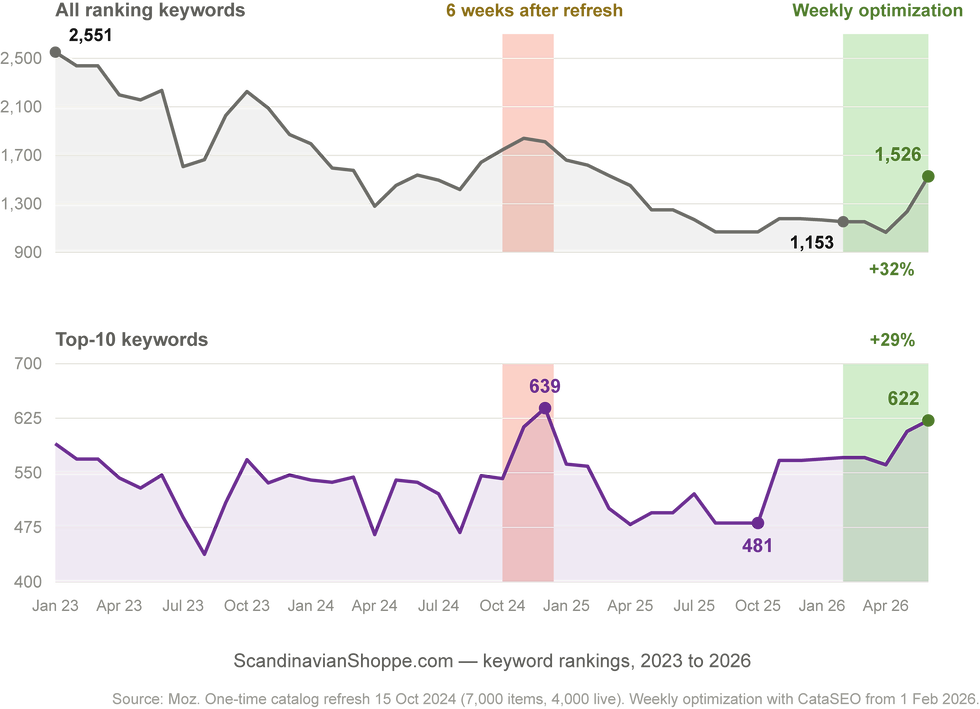
Then the last mile of AI got finished. Not the clever part — the clever part, getting AI to write a good description in the store's voice, took an afternoon in 2024. The last mile was the system: descriptions generated in bulk, every one queued for the owner's approval before it touched the live store, metadata written to the same standard, and the whole thing running inside the store rather than through copy and paste.
Here is what happened next, from the same monthly tracker:
Ranking keywords: 1,065 in April → 1,546 in July → 1,507 in September. Up 42 percent from the bottom.
Top-ten keywords: 561 → 645. Up 15 percent.
Sessions, April to September: 19,242 → 24,322. Up 26 percent. Users up 24 percent.
That is the "25 percent lift" I have mentioned in conversation, and it came from the last mile of AI, not from the model. It is sessions and users over the five months after the last mile was finished, on a store that had been losing ground for sixteen months before that. No new products, no ad spend, no redesign. Just the work that had always been worth doing and had never been practical to do.
The Second Store: Holding Through an Update
One store is a story. Two is a pattern, so here is a second store, in a completely different category, that worked through its entire catalogue the same way: 580 descriptions written and approved by the owner, 61 more written and waiting on her, every one reviewed by a human who knows the products better than any model does.
Her numbers are quieter and, to me, more interesting. Between July and September 2026 her ranking keywords rose from 997 to 1,043, and her top-ten keywords stayed exactly where they were, at 280. Flat sounds like nothing until you remember that Google shipped a spam update in August aimed at pages written to rank rather than to help, and a lot of stores lost ground in it. She didn't lose a single top-ten ranking. When the content is honest and specific to the product, an update that punishes thin content leaves you alone.
She also told me, in the same week, that she was in the middle of moving her warehouse to another state and hadn't been near a computer. That is the whole point. The last mile had been built so that the work kept its value while she ran her business.
Why the Lift Lives in the Last Mile
Go back to Feroz. "When content generation becomes cheap, trust becomes expensive." For a store owner, trust means two things: trusting that what goes live is right, and trusting that it won't break what already works. Neither of those is a generation problem. Both are last mile of AI problems — approval queues, one-click undo, writing into the store's own fields instead of around them.
So when someone asks me whether AI is "real" for a small business, this is my answer. The demo is real; everyone has seen the demo. The money is in the ten months between the demo and the tracker turning, and almost nobody is willing to spend them there, because the last mile is boring. It is a thousand small, nagging tasks, done correctly, inside somebody else's software.
That is also the bet we made in the last gold rush, and it's the bet I'm making in this one: the pain of a problem has to exceed the friction of the fix before anyone adopts anything. Seven thousand stale descriptions were pain enough. What changed was the friction.
What I'd Tell a Peer
If you run a store, or any business with a long tail of small, repetitive work, three things from these two field notes:
Measure the decay before you fix anything. You can't see a last-mile win without a baseline, and the baseline is almost always worse than you think.
Put the approval step inside the system, not in your inbox. The second owner kept her gains while moving a warehouse because nothing went live without her, and nothing waited on her to copy and paste.
Judge the lift in months, not days. The first store took five months from the bottom of the chart to a quarter more traffic. Nothing about the last mile of AI is instant, which is exactly why so few people finish it.
I'll keep publishing these as the numbers come in. Two stores is a pattern. Ten is a thesis.


